

Across Europe, the housing affordability crisis is reshaping the social contract: young people are delaying independence, households are tolerating substandard conditions, and steady employment no longer guarantees a key to a home. What was once treated as a national or local problem is now being recognised as a shared European challenge as it affects the health, well-being, and livelihood of millions. In response to growing pressure from member states, the EU published its first-ever European Affordable Housing Plan in 2025, to tackle the housing crisis at an EU-level.
This Just the Facts examines the state of play, the EAHP and its proposed measures, and the future direction of EU housing policy.
The Housing Crisis
A European crisis?
The eviction of Maricarmen Abascal, a disabled 87-year-old woman, from her apartment in Madrid in September 2026, sparked nationwide protests and outrage across Spain against the backdrop of a housing crisis that many have been enduring since the 2008 financial crash. While the right to “decent” and “affordable” housing is recognised within the Spanish constitution, Maricarmen’s subsequent death serves as a poignant reminder that recognising housing as a social right means nothing if it is not enforced.
Housing unaffordability is not a new phenomenon, but emerging demographic, economic, and structural changes are exposing larger parts of the European population to its effects. Between 2013 and 2024, house prices in nominal terms have risen by nearly 60% and average rents by 20% across the EU. By comparison, EU household real income per capita grew by 22% between 2004 and 2024. This results in many people being “blocked”: they earn too much for state subsidies but too little to access accommodation provided by the private market.
National market structures, legal frameworks and financial systems vary considerably, and so does the severity of the crisis from one country to the next. The EU’s principal indicator of housing unaffordability, the housing cost overburden rate, tracks households spending more than 40% of disposable income on housing. Data suggests a positive downward trend as regards the housing cost overburden rate as some incomes have risen and these groups are faring well in the housing market. However, this can conceal the severity of the problem experienced by certain demographics and regions. Case studies covering Bulgaria, Ireland, Poland, Portugal, and Spain, and parts of Austria and Italy, found that unaffordability is so acute that in many places more than 80% of the median wage would be required to rent a standard two-room apartment. This data refers to youth specifically, as it has been shown that young people generally experience the housing crisis more acutely than older cohorts.
Instead, people are adapting to the market by postponing career changes, mobility, family formation, or forced into exploitative living arrangements such as sex-for-rent. At the other end of the spectrum, people are experiencing homelessness or relying on emergency accommodation. Eurofound’s report ‘Foundational Challenges’ found that young people are disproportionately affected by the housing crisis and frames the housing deficit as a mismatch between housing availability and people’s ideal living arrangements.
Ireland’s housing situation – an outlier in European housing data?
Following a fact-finding mission to Dublin from 26-28 May 2026, Italian MEP Irene Tinagli, chair of the European Parliament’s Special Committee on the Housing Crisis, described Ireland’s housing crisis as one of the “most severe” and “most complicated” in Europe, with “affordability” at its core.
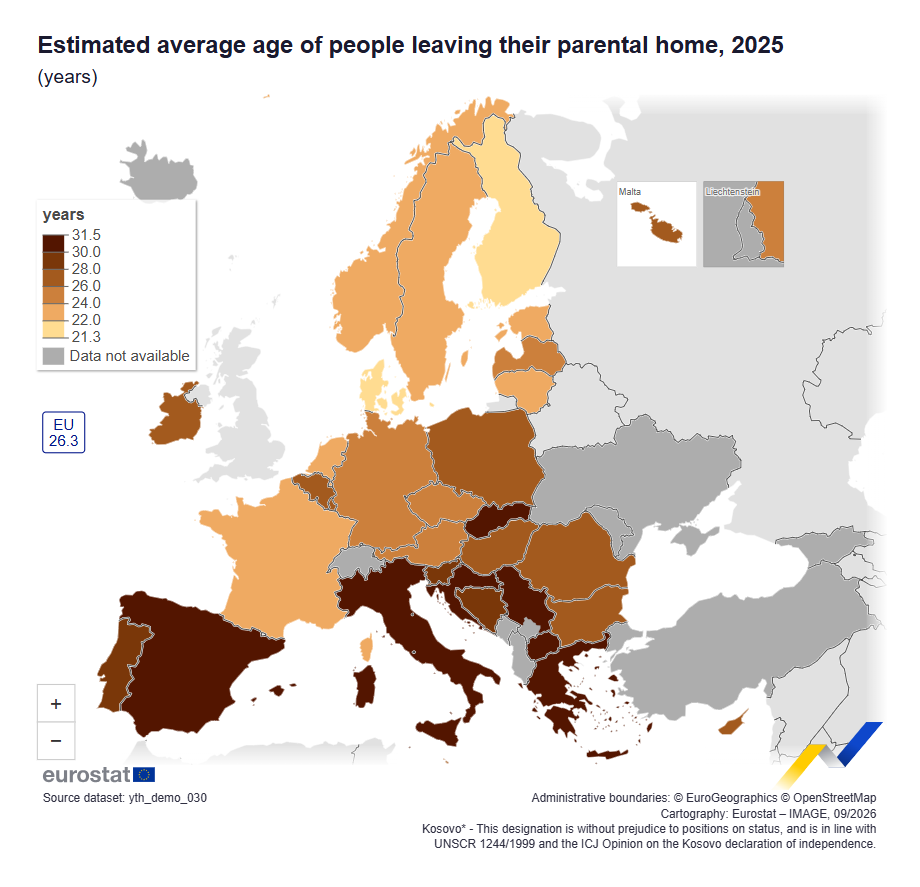
Between 2018 and 2023, Ireland saw a significant 17% increase in young adults living in the parental home. In 2025, the average age for young people to move out of their parents’ house was almost 27 years old, slightly higher than the EU average. Eurostat figures from June 2026 showed that Ireland is the second-most expensive country for housing, health costs and electricity, with prices 36% higher above the EU average. Meanwhile, looking at longer-term trends, between 2010 and 2025, Ireland saw a 115% increase in rent prices – among the highest recorded in the EU. Protests in Ireland in September 2026 also highlighted the growing discontent and reality for workers, whose “wages are swallowed by housing”.
What is the EU Affordable Housing Plan (EAHP)?
The Liège Declaration 2024 marked a turning point in the EU’s housing policy direction, when Housing Ministers called for a coordinated response to ensure “affordable, decent, and sustainable housing for all in the EU”. The EU appointed Dan Jørgensen as its first-ever Commissioner with housing in their portfolio in December 2024 and presented its first EU Affordable Housing Plan and accompanying recommendation in December 2025.
The Plan rests on four pillars: boosting supply; mobilising investment; enabling immediate support while driving reforms; and supporting those most affected by the housing crisis. These four pillars and specific initiatives to achieve them are outlined in more detail below. Although housing policy will remain a local and national competence, this wide-ranging legislative package seeks to free up public cash, boost supply, crack down on short-term rentals, and offer legislative and administrative relief to member states.

The European Strategy for Housing Construction
The European Commission estimated that the EU needs more than two million new homes a year, but construction has failed to keep up with expanding demographic demand in one third of EU regions. The aim of the European Strategy for Housing Construction (ESHC) is to modernise and strengthen the construction sector by cutting red tape, speeding up permit processes, promoting digitalisation and innovation such as an ‘AI-first’ approach, reskilling workers and attracting new talent to this sector.
Evidence presented at the EU Housing Summit 2025 in Galway identified bottle necks in housing delivery, such as unpredictable and prolonged planning and consenting processes. For example, the Central Bank of Ireland found that homes are taking twice as long to deliver compared to a decade ago, doubling from 21 to 26 months to 44 to 50months in this period.
The New European Bauhaus (NEB) has been described as the Commission’s bid “to marry climate-conscious urban development with aesthetic design”, and the “soul” of the European Green Deal. It is funded across multiple EU programmes and supports local tangible action by supplying tools and direct financing to communities. For example, under Town Centre First Heritage Revival Scheme (THRIVE), €63 million in government and EU co-funding was awarded to local governments in the Southern, Eastern & Midland Regions of Ireland to restore derelict and heritage buildings in September 2025.
This complements the EU’s Affordable Housing Plan which focuses on renovating and repurposing existing buildings to reduce emissions and rewarding net-zero projects as part of the wider green transition.
The EU shapes housing policy partly through state aid regulations. These regulations were revised in December 2025 to allow for more flexibility to directly intervene in the housing market to provide housing to a larger cohort. Affordable housing is now explicitly included alongside social housing among the categories exempt from notification and without compensation caps.
Pan-European Investment Platform for Affordable and Sustainable Housing To date, €43 billion has been mobilised under the MFF 2021-2027 for housing. The Commission intends to scale up targeted investment by working with the European Investment Bank (EIB), which will also partner with a wide network of banking institutions to form the Pan-European Investment Platform (PEIP). The platform is intended to provide a more coordinated framework for investment in affordable and sustainable housing. By pooling projects and supporting long-term financing, it could help attract additional public and private capital.
Short-term rentals (STR) have surged by 93% between 2018 and 2024. While they play a crucial role in revitalising rural communities across Europe, unregulated growth can further place pressure on long-term housing prices.
National and local authorities are introducing new measures to address the unregulated rise of STR. In February 2026, Ireland proposed restrictions on STR in towns with populations over 20,000. This affects the provision of STR and property –use and interferes with Article 56 of the Treaty on the Functioning of the European Union (TFEU), which guarantees the free movement of services and prohibits unjustified national restrictions within the Single Market. However, the Court of Justice of the European Union (CJEU) established a crucial precedent with Cali Apartments (2020), ruling that member states can restrict Airbnb-style STRL where justified by overriding public-interest. However, due to the fragmented nature of the legal framework, many European cities have developed their own frameworks, generating imbalances between local markets.
This gap identified the need for a common methodology to allow for a more harmonised process across the EU. As a result, the Commission proposed the EU Affordable Housing Act (AHA), which was formally adopted on 9 September 2026. In its current form, it acts as a rulebook that sets out three conditions which national, regional, and local governments, referred to as “competent authorities”, must satisfy before they take “justifiable” action in areas under “housing stress”.
The Act stipulates that in order to restrict STR, the competent authority must be already applying and enforcing the EU STR Regulation 2024/1028, which introduces a common EU framework to harmonise transparency, registration, and data-sharing but does not replace national, regional or local rules.
The EU AHA must now proceed through the ordinary legislative procedure, during which the Parliament and the European Council negotiate and amend the text accordingly before adopting the legislation.
Ireland’s Response
Responses to the EAHP
The EU AHA has received mixed reactions. MEP Aodhán Ó Riordáin welcomed it as a “tool to act against some of the key forces driving families out of their homes”. MEP Kathleen Funchion highlighted that it could offer relief to disproportionately affected areas, such as the Gaeltacht, where the number of entire homes on Airbnb increased by 88% since 2019. In Gaeltacht areas, the housing pressure threatens not only affordability but the survival of the Irish language itself.
Others have criticised the Housing Act for its limitations. MEP Regina Doherty said that “it will not build a single home” and argued that derelict and vacant properties should be addressed as well. The vacancy rate in Ireland remains unchanged at 3.7%, with 81,373 vacant units recorded nationwide, and 19,137 properties listed as derelict.
Another challenge in the Irish context is that Ireland does not have an accurate STR database as the previous register was discontinued in 2008. Although there have been calls for a STR register, it will not be established until December 2026. The lack of data has led to some Irish businesses to voice their concerns that the Act has added another degree of uncertainty, and without protection from the Commission raises the question: who will monitor new restrictions that go beyond the law?
Economist Dr. Ronan Lyons argues that rather than a “bubble waiting to pop”, Ireland suffers from a “brittle” housing system – one that has lost the ability to respond. While the EAHP and its measures will not solve the housing crisis in Ireland, they will, however, shift accountability back to Ireland, with housing affordability now recognised as an EU-wide structural risk.
Housing as a constitutional right?
Beyond EU policy, debate over whether housing should be enshrined as a legal right within the Irish constitution has returned to the political agenda. Home for Good, a coalition including leading housing charities and legal experts, has been campaigning for a referendum since 2020 but opinion remains divided. The Housing Commission, an independent 12-member housing expert body, was tasked by the Irish government to examine and report on a referendum on housing. Differing views within the Commission on the merits of including the right to housing in the Constitution, led to two separate reports: an overall majority report and a minority report. As a result, the Housing Commission failed to reach a consensus. However, both sides agreed that the existing constitutional framework did not pose a barrier to the Oireachtas taking action to address the situation. In October 2026, the Dáil debated a 41st Amendment of the Constitution (Right to Housing) Bill, which mirrored the wording provided in the majority report. At EU level, a European Citizens’ Initiative is calling to make housing a right.
Next steps
Ireland’s Budget 2027 allocated more than €9.1 billion in capital investment for housing, including just over €3 billion for social housing delivery. However, organisations like Dublin Simon Community criticised the modest increase in homelessness funding and described the of lack of concrete measures as a “significant missed opportunity”, falling short of the ambitious response required.
Many organisations have urged for prevention-focused policies and housing-first approaches and stressed that the EAHP must ensure that public money serves people and not speculation. Earmarking funding for city-led programmes that end homelessness like Housing First would tie EU-level ambition to local and measurable outcomes. Ireland’s EU Presidency is spearheading the EU housing agenda through the progression and implementation of the EAHP, including a proposal for a Council recommendation on fighting housing exclusion and the Affordable Housing Act. Ireland will also work closely with the EU Housing Taskforce, established by the Commission in early 2025, to implement the EAHP. Key actions will be advanced at events such as the Informal Meeting of EU Housing Ministers (25 November 2026) and meetings on combating homelessness (26 November). The European Commission intends to present a Housing Simplification Package, aiming to cut red tape and simplify administrative processes, in 2027.
Thanks for reading! You have reached the end of this article. Further related content is available in the library below. To receive future updates, consider subscribing to ensure you do not miss new publications.

Just the Facts | The EU and International Humanitarian Law
With international law and multilateral institutions under growing attack, defending international humanitarian law (IHL) and the International Criminal Court (ICC) matters more than ever. But what does IHL entail in practice, and what role do Ireland and the EU play in upholding it? This Just the Facts explains the key principles of IHL, the escalating…

Just the Facts | Protests around Europe
September and October 2026 have been marked by widespread protests across Europe – from Spain and France to Austria and Albania. While their immediate causes vary by country, they share a common root: the growing affordability crisis for young people. This Just the Facts looks at the protests in France, Italy, Greece, Spain and Portugal,…
Just the Facts | What is the Affordable Housing Plan?
Across Europe, the housing affordability crisis is reshaping the social contract: young people are delaying independence, households are tolerating substandard conditions, and steady employment no longer guarantees a key to a home. What was once treated as a national or local problem is now being recognised as a shared European challenge as it affects the…

Just the Facts | German State Elections in September 2026
Around 7.4 million Germans went to the polls in September to vote in elections in three of Germany’s sixteen federal states: Saxony-Anhalt, Mecklenburg-Western Pomerania and Berlin. The far-right AfD emerged as the largest party in the former two states, while the far-left Die Linke secured the most seats in the capital. Despite the AfD’s growing…

Just the Facts | State of the Union Address 2026
On 16 September, European Commission President Ursula von der Leyen delivered her sixth annual State of the Union address, setting out the Commission’s priorities and shaping the EU agenda for the year ahead. This year’s speech focused on issues including climate, AI, security and migration. A notable feature was the presence of Canadian Prime Minister…

Just the Facts | Upcoming Elections in France, Sweden, Spain & Implications for the EU
Over the next year, a number of EU member states will hold elections. As national governments shape negotiations at EU Council level, the outcomes of these elections will have implications for the functioning of the EU going forward. In May 2027, French presidential elections will take place. Spanish citizens will elect a new government by August 2027, and Sweden will form a new government following elections in September 2026. This…

Just the Facts | What is the EU’s Temporary Protection Directive?
Following Russia’s full-scale invasion of Ukraine in February 2022, the European Union activated the Temporary Protection Directive for the first time, providing millions of forcibly displaced Ukrainians with immediate access to residence, work, education, and essential services across EU Member States. With the Directive set to expire in March 2028, discussions are emerging over whether…
Just the Facts | Heat Protection Measures in the EU
With record temperatures across Europe in recent weeks, and hotter summers yet to come, the urgent need for government action on climate change has become even clearer. This Just the Facts provides an overview of key EU measures both to mitigate climate change and adapt to its effects, the unequal risks of excessive heat, and where Ireland and its Presidency programme stand on climate action. Introduction June 2026 will…

Just the Facts | Ireland’s Presidency of the Council of the EU
On 10 June, the Irish government launched the programme and priorities for its Presidency of the Council of the EU, which will begin on 1 July and end on 31 December 2026. The programme is entitled “Ní neart go cur le chéile – Strength with unity”. The priorities are centred around three distinct pillars: competitiveness,…
Just the Facts | What “One Europe, One Market” means for Ireland
The Single Market is the EU’s most powerful economic asset – yet barriers to cross-border trade, services and innovation remain. Divergent national regulations and slow implementation of legislation can impact both businesses and consumers. The One Europe, One Market Roadmap, signed by the EU institutions in April 2026, sets out a programme of legislative and policy measures to address these gaps by the end of 2027. However, responses to the One Europe, One Market Roadmap have exposed some tensions between the…

Just the Facts | Irish and Multilingualism in the EU
“The language of Europe is translation” – Umberto Eco Multilingualism is a founding principle of the EU, reflecting its cultural and linguistic diversity. Under this policy, the EU aims to ensure that all citizens have access to EU information in their own languages, thus enabling engagement and promoting transparency and equality between Member States. Currently, the EU has 24 official languages, with Irish…

Just the Facts | Savings and Investment Union
Household savings across the EU are estimated at €10 trillion – at a time when Europe requires significant investments to meet global challenges. The European Commission’s proposed Savings and Investment Union (SIU) seeks to expand investment opportunities for citizens while strengthening access to finance for European businesses. This Just the Facts outlines the key features…

Just the Facts | Hungarian Elections
Key takeaways Number of voters on voter list: 8.2 million Voter turnout: a record level of over 77% (up from 63% in 2022) Péter Magyar’s centre-right, pro-European Tisza party won 54% of the vote – significantly ahead of Viktor Orbán’s Fidesz party at 37%. With this, Tisza has secured a supermajority of two-thirds, which is sufficient to reform key laws…

Just the Facts | Elections in Slovenia and Denmark in March 2026
March 2026 saw elections held in two EU member states: Slovenia and Denmark. In Slovenia, the incumbent centre-left Freedom Movement led by Prime Minister Robert Golob secured a narrow margin over the right-wing Slovenian Democratic Party under Janez Janša. Meanwhile, in Denmark, the incumbent Social Democratic government under Prime Minister Mette Frederiksen suffered its worst…

Just the Facts | Mercosur Update
After 25 years of negotiation, the long-awaited EU- Mercosur trade deal looks to be on the brink of enactment. The deal brings together two of the largest trading blocs in the world and creates a free trade area of over 700 million people, covering more than 20% of global GDP. In this Just the Facts…