

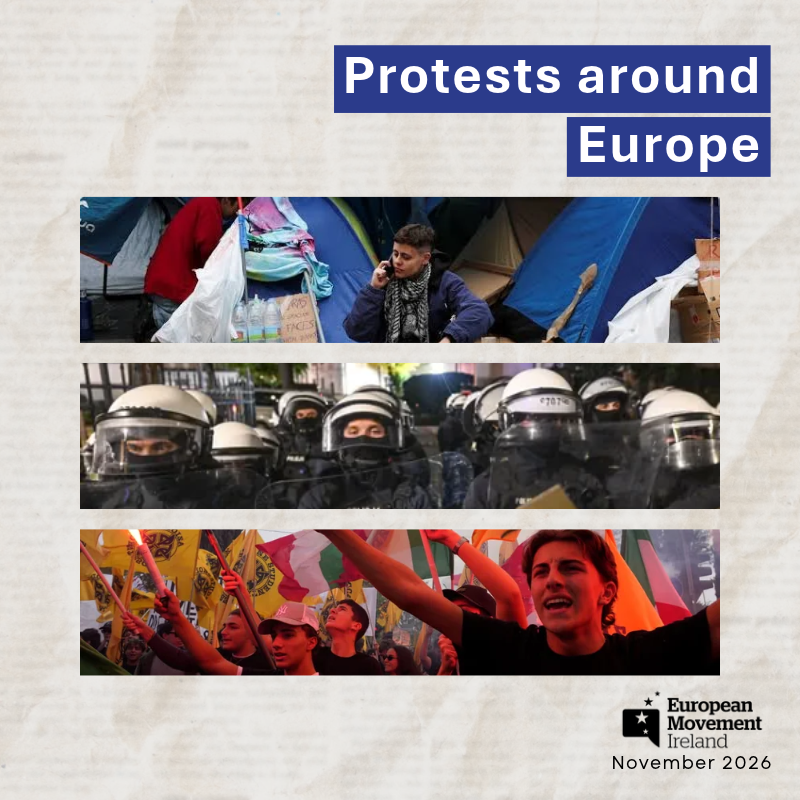
September and October 2026 have been marked by widespread protests across Europe – from Spain and France to Austria and Albania. While their immediate causes vary by country, they share a common root: the growing affordability crisis for young people. This Just the Facts looks at the protests in France, Italy, Greece, Spain and Portugal, which have been among the largest in the EU, along with the Irish context and reactions to the protests.
Hundreds of thousands of secondary-school pupils began protesting across France on 17 September over poor learning conditions, including dilapidated, ill-equipped school buildings and prolonged staff absences. The pupils were soon joined by university students, trade unions and others protesting against rising living costs, including fuel prices. By 17 October, the movement had grown to about 800,000 people nationwide. That weekend brought widespread rioting and looting, along with incidents of violence, arson and damage to historic monuments in Paris and other cities such as Limoges. On 18 October alone, the French Interior Ministry reported that nearly 2,400 people were arrested and about 1,000 police and gendarmes injured.
Demonstrations of a similar size continued into the following week. On 24 October alone, more than 1,300 arrests were made as hundreds of thousands of people took part in protests across France. Prime Minister Sébastien Lecornu called the unrest the most violent in decades. However, the French government has faced criticism over its crack-down on the right to peaceful protest and excessive use of force, particularly after a 15-year-old boy’s hand was blown off by a stun grenade in Paris on 5 October, as well as other cases of severe injuries due to police violence.
In an address to the nation on 18 October, President Emmanuel Macron acknowledged the “deep anxiety” of young people and vowed that rioters and looters would “pay for their crimes”. However, he offered no concrete policy initiatives, no cabinet reshuffle and no new public spending. His speech was almost universally condemned, underscoring his increasingly weakened and isolated political position.
The protests came amid political tension in France, as Macron’s term is due to end in April 2027. Presidential hopefuls seized on the protests to position themselves for next year’s election. Leading right-wing figures have criticised rioters, while left-wing leaders backed the union-led protests – and both sides blame Macron for the unrest. Current polls suggest that voters will ultimately face a choice between far-right populist leader Marine Le Pen of the Rassemblement National (RN) and Jean-Luc Mélenchon of the far-left La France Insoumise (France Unbowed).
On 13 October, Greek students took to the streets of Athens to protest the high cost of living, particularly student housing, and the lack of funding for public education. The protests continued on 21 October, when around 10,000 secondary and university students and teachers demonstrated for increased state funding for education and better facilities. Other cities in Greece saw similar marches in solidarity with France and elsewhere.
Like France, the protests came as Prime Minister Kyriakos Mitsotakis and his centre-right government face growing pressure ahead of the mid-2027 elections. Greek workers are among the poorest in Europe, facing stagnant wages, high rents and rising energy costs. The average monthly salary in Greece is €1,500, unchanged since 2009. In 2024, around 35.5% of household income in Greece was spent on housing costs – the highest share in the EU, while rent prices continue to climb faster than the EU average.

On 16 October, Italian students in major cities including Milan, Turin, Bologna, Genoa, Verona, Rome and Bari held largely peaceful protests against the government’s education policies and the cost of living. The annual “No Meloni Day” protests were brought forward to October to build on the momentum from France. Besides grievances about poor school infrastructure, precarious teaching contracts and the high cost of living, the students also protested the Valditara decree passed by the government in September 2026. The decree caps the proportion of pupils without Italian citizenship at 30% per class and imposes a ban on burqas for pupils and teachers. There were reports of isolated violent incidents, and several mobilisations were met with a disproportionate response by security forces, including the use of water cannon and tear gas.
Thousands protested again on 24-25 October over a range of issues, including the rising cost of living, the national government and wars in the Middle East. After the previous week’s demonstrations, authorities significantly increased the presence of police and soldiers in public spaces. In Milan alone, more than 200 people were arrested on 27-28 October, 80% of them minors. Further protests took place on 30 October, with Italian trade unions mobilising and also calling on their peers across Europe and globally to protest against arms shipments and “the militarisation of ports”.
The eviction of Maricarmen Abascal, a disabled 87-year-old woman, from her Madrid apartment on 23 September 2026 sparked housing protests that have grown into Spain’s largest housing mobilisation in years. A general strike is planned for 11 November and a snap general election was called for 29 November after reforms proposed by Prime Minister Pedro Sánchez were rejected by a majority in the Spanish government.
Protesters have been camped in central Madrid since the eviction. As of 29 October, no protest encampments had been forcibly removed by police, but protesters face fines, stigmatisation and harassment, along with growing judicial, administrative, and political pressure.
Tens of thousands of people have been protesting in Lisbon, Porto, Aveiro, Braga, Funchal, Faro and Coimbra since 10 October under the slogan “We can no longer live like this”. As in Spain, the protests in Portugal have centred on housing costs. House prices in Portugal have more than doubled since 2017, while renters have faced similar increases, fuelling one of Europe’s most acute housing affordability crises.
On several occasions, police baton-charged housing protesters, forcing them to dismantle their camps during the night in Lisbon and Porto. On 25 October, more than 30 people were arrested in the two cities. According to the group Casa Para Viver (A Home to Live In), more than 20 people were injured in the raids, as police deployed rubber bullets and crowd-control dogs. The Lisbon and Porto camp movements are demanding measures including the reversal of a new rental law that virtually eliminates tenants’ rights, an end to evictions of people with no housing alternative, and a cap on rents.
Up to 3,000 students took part in protests in Dublin on 1 October over education costs, either marching through the city or engaging in walkouts. Aontas na Mac Léinn in Éirinn (AMLÉ), the national students’ union of Ireland, called for the funding gap to be reduced, for purpose-built, publicly owned student accommodation, and for support for commuting students.
New data from the Central Statistics Office (CSO) show that people under the age of 35 experienced the steepest rise in living costs in September 2026, up 4.4% from September 2025, against an overall average of 4.1%. Rent was the biggest driver, accounting for 1% of that increase. Between September 2021 and 2026, the rent index increased by 36.1%. Households with the lowest incomes also experienced an above-average increase in living costs of 4.2% in September 2026.
These figures underscore young people’s concerns about housing and affordability: polling by the National Youth Council of Ireland (NYCI) found that almost seven in ten young adults (18-24) in Ireland are considering moving abroad for a better quality of life. Worries about employment have also increased significantly, with 90% of young adults saying it is difficult to find secure, well-paid work.
Reactions to the protests
Instead of listening to young people’s legitimate concerns, many European leaders chose to scapegoat migrants for the unrest. In particular, right-wing political leaders inside and outside the EU have instrumentalised the unrest to advance their anti-immigration agendas. Italian Prime Minister Giorgia Meloni cited immigration as a factor in the Milan protests, claiming that “nearly half of those stopped or arrested” were “of immigrant background”. In France, Marine Le Pen of the far-right RN blamed “decades of immigration” to France for the looting and destruction, without any evidence. In Germany, Alternative für Deutschland (AfD) co-leader Alice Weidel called the “violent excesses” in France a “warning for Germany”, criticising the EU’s “open borders” and calling for radical anti-migrant reforms. Hungarian Prime Minister Péter Magyar said the riots in France justified Hungary’s tough migration stance, while Polish Prime Minister Donald Tusk implied a link between the protests and immigration to Europe.
Beyond Europe, US President Donald Trump, speaking just two weeks before the midterm elections, blamed the unrest in France on immigration, despite the fact that police have not explicitly established such a link, and urged the EU to close its borders. President Macron responded by condemning the “unacceptable and stupid comments from many foreign leaders”.
The excessive use of force by police at the protests, particularly in France, was met with national and international concern. Amnesty International called the response by French police to student protests in early October “disproportionate” and urged French authorities to uphold their human rights obligations. In a statement on 20 October, UN High Commissioner for Human Rights Volker Türk expressed concern about reports of “unnecessary and excessive use of force against protesters, including children” in Albania, Belgium, France, Italy and Portugal. He urged states to engage in constructive dialogue and “address legitimate and fundamental human rights concerns”. UN Special Rapporteur on freedoms of association and peaceful assembly, Gina Romero, echoed this, calling on states to address young people’s concerns and to ensure their response is “focused on dialogue and not on unnecessary use of force.”
The unrest in France, Italy and Belgium was escalated to the European Parliament on 20 October, when MEPs backed a joint motion for an emergency debate tabled by the centre-right European People’s Party (EPP) and the European Conservatives and Reformists (ECR) Group. Counter-motions from the Left Group and the Progressive Alliance of Socialists and Democrats Group, which sought debates on the right to protest and on the impact of rising prices on young people were rejected.
Key commonalities – and a call to action
Although the immediate causes of the protests differ, some have tried to portray them as a single, coordinated youth revolt spreading across Europe. This narrative undermines specific national contexts and demands while deepening divisions, to the benefit of the radical right parties vying for power across the EU.
Nonetheless, at the heart of the protests lies a shared sense of despair among large parts of Europe’s population, particularly the youth, but also professions such as teachers, truck drivers, farmers and dockworkers, over the affordability crisis and a sense of being abandoned by their national governments. For Europe’s youth, this is most visible in rising rent and house prices, underinvestment in education, and poor job prospects. For many Europeans, the social contract that served previous generations is breaking down.
The TUI Foundation’s 2026 Youth Study reflects this. It found that 52% of young people aged 16-26 across seven European countries expect to be worse off than their parents, while only 25% expect to do better. At the same time, youth unemployment remains substantially higher than overall unemployment: under 25-year-olds are more than twice as likely to be unemployed compared to the population as a whole. Artificial intelligence (AI) is likely a contributing factor: one study of French companies found a sharper decline in permanent hiring among workers aged 21-29 in occupations exposed to AI. In response to these challenges, the European Economic and Social Committee (EESC) has called for the equal treatment of young people in the labour market.
Yet public investment in education continues to fall. In France, state spending per student dropped by more than 20% between 2008 and 2026. Ireland ranks lowest of all OECD countries in terms of investment in education, at just 2.6% of GDP, down from 3.6% in 2015.
Young people’s largely peaceful participation in civic life should be welcomed rather than actively repressed – not least because states have the obligation to facilitate the right to peaceful protest, but such police brutality also only serves to further erode trust in government. Eurobarometer data from October 2026 shows a growing number of young people in the EU are actively engaging in democratic and civic life (55%, up from 48% in 2024). At the same time, there is a clear mandate for both national governments and EU institutions to take the generational threats seriously. Asked what they expect the EU to deliver for their generation, young people most often mentioned fighting poverty and economic and social inequalities (32%) and creating more job opportunities for young people (31%), along with preserving peace (33%). That starts with treating young people as genuine partners in all policy dialogue, particularly when it comes to implementing EU’s affordable housing agenda, the reinforced Youth Guarantee and the Youth Check, and including a youth perspective in the EU’s new Anti-Poverty Strategy, for example.
Are you a young person facing these issues? Register for European Movement Ireland’s youth dialogue on 5 November in South-East Technological University Waterford – we want to hear from you!
Thanks for reading! You have reached the end of this article. Further related content is available in the library below. To receive future updates, consider subscribing to ensure you do not miss new publications.
Just the Facts | The EU and International Humanitarian Law
With international law and multilateral institutions under growing attack, defending international humanitarian law (IHL) and the International Criminal Court (ICC) matters more than ever. But what does IHL entail in practice, and what role do Ireland and the EU play in upholding it? This Just the Facts explains the key principles of IHL, the escalating…
Just the Facts | Protests around Europe
September and October 2026 have been marked by widespread protests across Europe – from Spain and France to Austria and Albania. While their immediate causes vary by country, they share a common root: the growing affordability crisis for young people. This Just the Facts looks at the protests in France, Italy, Greece, Spain and Portugal,…
Just the Facts | What is the Affordable Housing Plan?
Across Europe, the housing affordability crisis is reshaping the social contract: young people are delaying independence, households are tolerating substandard conditions, and steady employment no longer guarantees a key to a home. What was once treated as a national or local problem is now being recognised as a shared European challenge as it affects the…

Just the Facts | German State Elections in September 2026
Around 7.4 million Germans went to the polls in September to vote in elections in three of Germany’s sixteen federal states: Saxony-Anhalt, Mecklenburg-Western Pomerania and Berlin. The far-right AfD emerged as the largest party in the former two states, while the far-left Die Linke secured the most seats in the capital. Despite the AfD’s growing…

Just the Facts | State of the Union Address 2026
On 16 September, European Commission President Ursula von der Leyen delivered her sixth annual State of the Union address, setting out the Commission’s priorities and shaping the EU agenda for the year ahead. This year’s speech focused on issues including climate, AI, security and migration. A notable feature was the presence of Canadian Prime Minister…

Just the Facts | Upcoming Elections in France, Sweden, Spain & Implications for the EU
Over the next year, a number of EU member states will hold elections. As national governments shape negotiations at EU Council level, the outcomes of these elections will have implications for the functioning of the EU going forward. In May 2027, French presidential elections will take place. Spanish citizens will elect a new government by August 2027, and Sweden will form a new government following elections in September 2026. This…

Just the Facts | What is the EU’s Temporary Protection Directive?
Following Russia’s full-scale invasion of Ukraine in February 2022, the European Union activated the Temporary Protection Directive for the first time, providing millions of forcibly displaced Ukrainians with immediate access to residence, work, education, and essential services across EU Member States. With the Directive set to expire in March 2028, discussions are emerging over whether…
Just the Facts | Heat Protection Measures in the EU
With record temperatures across Europe in recent weeks, and hotter summers yet to come, the urgent need for government action on climate change has become even clearer. This Just the Facts provides an overview of key EU measures both to mitigate climate change and adapt to its effects, the unequal risks of excessive heat, and where Ireland and its Presidency programme stand on climate action. Introduction June 2026 will…
Just the Facts | Ireland’s Presidency of the Council of the EU
On 10 June, the Irish government launched the programme and priorities for its Presidency of the Council of the EU, which will begin on 1 July and end on 31 December 2026. The programme is entitled “Ní neart go cur le chéile – Strength with unity”. The priorities are centred around three distinct pillars: competitiveness,…
Just the Facts | What “One Europe, One Market” means for Ireland
The Single Market is the EU’s most powerful economic asset – yet barriers to cross-border trade, services and innovation remain. Divergent national regulations and slow implementation of legislation can impact both businesses and consumers. The One Europe, One Market Roadmap, signed by the EU institutions in April 2026, sets out a programme of legislative and policy measures to address these gaps by the end of 2027. However, responses to the One Europe, One Market Roadmap have exposed some tensions between the…

Just the Facts | Irish and Multilingualism in the EU
“The language of Europe is translation” – Umberto Eco Multilingualism is a founding principle of the EU, reflecting its cultural and linguistic diversity. Under this policy, the EU aims to ensure that all citizens have access to EU information in their own languages, thus enabling engagement and promoting transparency and equality between Member States. Currently, the EU has 24 official languages, with Irish…

Just the Facts | Savings and Investment Union
Household savings across the EU are estimated at €10 trillion – at a time when Europe requires significant investments to meet global challenges. The European Commission’s proposed Savings and Investment Union (SIU) seeks to expand investment opportunities for citizens while strengthening access to finance for European businesses. This Just the Facts outlines the key features…

Just the Facts | Hungarian Elections
Key takeaways Number of voters on voter list: 8.2 million Voter turnout: a record level of over 77% (up from 63% in 2022) Péter Magyar’s centre-right, pro-European Tisza party won 54% of the vote – significantly ahead of Viktor Orbán’s Fidesz party at 37%. With this, Tisza has secured a supermajority of two-thirds, which is sufficient to reform key laws…

Just the Facts | Elections in Slovenia and Denmark in March 2026
March 2026 saw elections held in two EU member states: Slovenia and Denmark. In Slovenia, the incumbent centre-left Freedom Movement led by Prime Minister Robert Golob secured a narrow margin over the right-wing Slovenian Democratic Party under Janez Janša. Meanwhile, in Denmark, the incumbent Social Democratic government under Prime Minister Mette Frederiksen suffered its worst…

Just the Facts | Mercosur Update
After 25 years of negotiation, the long-awaited EU- Mercosur trade deal looks to be on the brink of enactment. The deal brings together two of the largest trading blocs in the world and creates a free trade area of over 700 million people, covering more than 20% of global GDP. In this Just the Facts…