

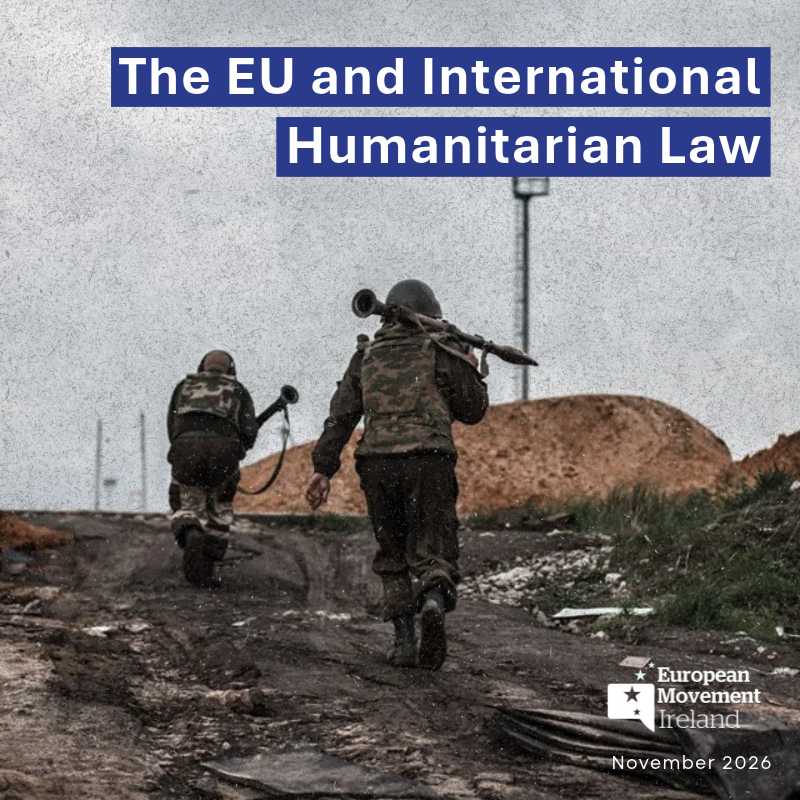
With international law and multilateral institutions under growing attack, defending international humanitarian law (IHL) and the International Criminal Court (ICC) matters more than ever. But what does IHL entail in practice, and what role do Ireland and the EU play in upholding it? This Just the Facts explains the key principles of IHL, the escalating US threats to the ICC, and the responsibilities of Ireland and the EU in promoting respect for IHL.
- International humanitarian law (IHL) is a set of rules that aims to protect civilians and limit the harm caused during war.
- The EU acts as a coordinator, amplifier, and, where possible, enforcer of the IHL obligations held by its Member States. It does this through humanitarian aid, controls on arms exports and its Common Foreign and Security Policy.
- A report by the Irish Red Cross found that 88% of respondents believe the EU should promote IHL internationally and ensure compliance by its Member States.
- The International Criminal Court (ICC), a cornerstone of IHL, has faced US sanctions since February 2025. On 9 October 2026, the US announced sanctions on the Court as an institution, in line with the stated aim of the US government to dismantle it.
- The EU has condemned the sanctions but not taken any significant action in response. Human rights groups have repeatedly urged the EU to activate its Blocking Statute, which would prevent EU companies and individuals from obeying foreign sanctions of this kind and could help protect the Court.
- Ireland will sit on the UN Human Rights Council from 2027 to 2029, which gives it a particular responsibility to advocate for IHL and help enforce it.
What is International Humanitarian Law?
International humanitarian law (IHL) – also known as the Law of Armed Conflict or the Law of War – is a set of rules that seeks to limit the effects of armed conflict. It is laid out in the 1949 Geneva Conventions and their Additional Protocols and many elements of IHL are now accepted as customary law. IHL aims to protect those who do not, or can no longer, participate in hostilities, such as civilians, the wounded and prisoners of war, while seeking to limit the inhumanity of war. It also sets out the responsibilities of states and non-state armed groups, including rapid and unimpeded passage for humanitarian aid and the protection of civilians (humanitarian workers included), healthcare and other objects indispensable to civilian survival.
There are currently over 130 active armed conflicts worldwide, more than double the number 15 years ago. Although 195 states worldwide are party to the Geneva Conventions, adherence to even the most fundamental humanitarian rules is lacking in many warzones and continues to be eroded, with devastating impacts for civilians in Gaza, Myanmar, Sudan, Ukraine and elsewhere. For example, IHL prohibits forced displacement, yet the number of forcibly displaced people due to persecution, conflict, violence or human rights violations has grown over the past decade, reaching more than 117 million globally in 2025.
Respect for IHL requires more than rules and statements; it demands accountability for violations of IHL. However, human rights experts report growing impunity for pervasive violations of IHL, with little political will to hold perpetrators to account. A September 2026 report by the Irish Red Cross reveals a gap between public support for IHL and confidence in its implementation. Fewer than half of respondents (46%) think the rules are effective in reducing suffering in conflicts around the world, while only 14% feel they are being respected in today’s conflicts.
The EU’s role in upholding IHL
IHL sits at the intersection of the EU’s core values, its foreign policy mandate and legal obligations flowing from the Geneva Conventions. As the EU is not a state, it is not itself a party to the four Geneva Conventions, but all 27 Member States are. In practice, the EU acts as a coordinator, amplifier, and, where possible, enforcer of obligations its members hold individually.
Under Article 2 of the Treaty on European Union (TEU), human rights, democracy, freedom, equality and the rule of law are fundamental values of the EU and are enforced through Article 7. According to rulings of the Court of Justice, these translate into legally binding principles for Member States. These principles formally enter the EU’s foreign policy under Articles 3(5) and 21 TEU, which commit the EU’s external action to preserving peace, strengthening international security, and upholding international law.
In practice, the EU has several mechanisms to promote and uphold IHL, including:
- Humanitarian aid. Aid is delivered according to the humanitarian principles of humanity, neutrality, impartiality and independence, enshrined in the European Consensus on Humanitarian Aid, signed in December 2007 and reaffirmed in March 2021. Together, the EU and its Member States are the world’s largest humanitarian aid donor, delivering 35% of all aid in 2025, with a budget of €1.9 billion in 2026. Public support is strong across the EU: in 2024, 91% of EU citizens considered it important for the EU to fund humanitarian aid.
- Arms export controls. The EU has common rules governing the export of military technology and equipment, which require Member States to refuse an export licence where there’s a clear risk that the equipment could be used to commit serious IHL violations.
- Common Foreign and Security Policy (CFSP). Through the CFSP, the EU promotes peace, international security, cooperation, democracy, the rule of law and respect for human rights and fundamental freedoms. The EU’s 2020-2027 Action Plan on Human Rights and Democracy integrated IHL into this framework, reflecting the fact that IHL is a regular part of human rights dialogues with partner countries. IHL violations can also be sanctioned under the EU’s global human rights sanctions regime.
The EU also has a monitoring function: since 2018, the Working Party on Public International Law (COJUR) has published an annual voluntary report on the implementation of the 2005 EU Guidelines on promoting compliance with international humanitarian law (‘the Guidelines’).
However, these instruments are only as strong as the political will to apply them. A gap remains between the EU’s commitments on paper and their consistent application; for example, the EU has been accused of an inconsistent response and double standards regarding its response to Israel’s violations of international law in the Occupied Palestinian Territory and Lebanon, compared to its response to conflicts in other countries. This undermines the EU’s claim to uphold a “rules-based order” and damages its legitimacy on the global stage.
Public opinion supports a strong role for the EU in upholding IHL. According to the Irish Red Cross report, 90% of respondents agree that the EU should encourage respect for IHL, while 88% believe it should play a role in promoting IHL internationally and ensure compliance by all Members States. 84% say that the EU should be willing to sanction countries or groups that violate IHL, even if this carries economic costs for the EU.
Attacks on the International Criminal Court
The International Criminal Court (ICC) is a cornerstone of IHL and the international legal system. Established under the Rome Statute, which entered into force in 2002, it is the world’s only permanent tribunal to prosecute individuals for the gravest atrocities, including war crimes, crimes against humanity and genocide. As an independent court of last resort, it seeks to complement rather than replace national Courts. It has 125 member countries (known as States Parties), including all EU Member States. Ireland’s decision to join the ICC was approved by general referendum in 2001.
The ICC has faced repeated US sanctions since February 2025, following the arrest warrants it issued for Israeli Prime Minister Benjamin Netanyahu and former Defence Minister Yoav Gallant in November 2024. In 2026, new US sanctions targeted ICC judges and prosecutors, as well as UN Special Rapporteur Francesca Albanese. By early October 2026, the US government had sanctioned thirteen independent judges and prosecutors, including ICC President Tomoko Akane, stripping them of access to their payment cards, Microsoft software and all other services provided by US companies. On 9 October 2026, the US announced sanctions on the ICC as an institution (to come into effect after a 180-day grace period), in line with its stated aim of dismantling the Court. This measure would severely disrupt the ICC’s work and represents an unprecedented assault on international law.
The EU has denounced these attacks and continues to provide political and financial support to the ICC, including awarding it the 2026 Sakharov Prize for Freedom of Thought. However, it has not taken any significant retaliatory action, despite having a tool available to address these sanctions: the Blocking Statute. The Statute aims to shield EU economic actors against the negative effects of extraterritorial legislation (meaning a law imposed by one state on another without its consent). If activated, it would explicitly forbid such entities and individuals from complying with extraterritorial sanctions and could help to achieve a coordinated response at EU level.
In May 2026, Ireland called on the European Commission to amend the Blocking Statute so that it could be quickly activated to ensure the continued functioning of the ICC. In numerous resolutions in 2025 and 2026, the European Parliament has called for the amendment of the Blocking Statute to include the ICC. Meanwhile, human rights organisations around the world and the civil society-led Coalition for the ICC have repeatedly urged the EU to take stronger legal and diplomatic action against the US campaign.
Protecting IHL: The responsibility of Ireland and the EU
With Russia’s war of aggression in Ukraine and an unpredictable transatlantic partnership, security and defence have risen on the EU’s agenda. This is also reflected in increased spending, which risks overshadowing central pillars of the EU’s work on IHL, including humanitarian aid, civilian protection and accountability. In 2025, for the third consecutive year, 17 EU Member States cut their official development assistance (ODA) funding. Contrary to this trend, Ireland has increased the annual budget for Irish Aid since 2020, with an ODA budget of €855 million for 2027, €14 million more than in 2026. Ireland is now the world’s eighth largest contributor of ODA as a share of Gross National Income (GNI).
The Multiannual Financial Framework (MFF), the EU’s next long-term EU budget, is an opportunity to strengthen dedicated funding for humanitarian aid and peacebuilding, particularly under the Global Europe Instrument. That means protecting it from potential cuts, such as those proposed in the Irish Council Presidency’s negotiating box from October 2026. The Foreign Affairs and Development Committees in the European Parliament subsequently rejected the proposed cuts to Global Europe. Previously, on 9 July 2026, Parliament had adopted a resolution on the Commission’s joint communication on humanitarian aid from May. In it, MEPs expressed concern about the funding crisis in global humanitarian and development aid and warned against diverting attention and resources away from regions that need it most.
Ireland has a strong record of defending IHL which it can build on. It has ratified a large number of IHL treaties and helped to broker the Convention on Cluster Munitions, adopted by 107 states in Dublin in 2008. That same year, the Irish Government established a national committee on IHL, chaired by the Department of Foreign Affairs and Trade, to advise the Government on IHL matters and promote wider knowledge of IHL in Ireland.
More recently, on 13 October 2026, Ireland was elected to the United Nations Human Rights Council for a three-year term from 2027 to 2029. Its priorities include supporting the role of civil society and human rights defenders, championing gender equality, LGBTIQ+ rights and the rights of those with disabilities in conflict, as well as increasing attention on the fundamental right to adequate food. This role places a particular responsibility on Ireland to use its influence to stand up for IHL. Until then, as a matter of priority, Ireland should use the remaining weeks of its EU Council Presidency and Foreign Affairs Council meetings to call for the Blocking Statute to be urgently triggered to protect the ICC.
Thanks for reading! You have reached the end of this article. Further related content is available in the library below. To receive future updates, consider subscribing to ensure you do not miss new publications.
Just the Facts | The EU and International Humanitarian Law
With international law and multilateral institutions under growing attack, defending international humanitarian law (IHL) and the International Criminal Court (ICC) matters more than ever. But what does IHL entail in practice, and what role do Ireland and the EU play in upholding it? This Just the Facts explains the key principles of IHL, the escalating…
Just the Facts | Protests around Europe
September and October 2026 have been marked by widespread protests across Europe – from Spain and France to Austria and Albania. While their immediate causes vary by country, they share a common root: the growing affordability crisis for young people. This Just the Facts looks at the protests in France, Italy, Greece, Spain and Portugal,…
Just the Facts | What is the Affordable Housing Plan?
Across Europe, the housing affordability crisis is reshaping the social contract: young people are delaying independence, households are tolerating substandard conditions, and steady employment no longer guarantees a key to a home. What was once treated as a national or local problem is now being recognised as a shared European challenge as it affects the…

Just the Facts | German State Elections in September 2026
Around 7.4 million Germans went to the polls in September to vote in elections in three of Germany’s sixteen federal states: Saxony-Anhalt, Mecklenburg-Western Pomerania and Berlin. The far-right AfD emerged as the largest party in the former two states, while the far-left Die Linke secured the most seats in the capital. Despite the AfD’s growing…

Just the Facts | State of the Union Address 2026
On 16 September, European Commission President Ursula von der Leyen delivered her sixth annual State of the Union address, setting out the Commission’s priorities and shaping the EU agenda for the year ahead. This year’s speech focused on issues including climate, AI, security and migration. A notable feature was the presence of Canadian Prime Minister…

Just the Facts | Upcoming Elections in France, Sweden, Spain & Implications for the EU
Over the next year, a number of EU member states will hold elections. As national governments shape negotiations at EU Council level, the outcomes of these elections will have implications for the functioning of the EU going forward. In May 2027, French presidential elections will take place. Spanish citizens will elect a new government by August 2027, and Sweden will form a new government following elections in September 2026. This…

Just the Facts | What is the EU’s Temporary Protection Directive?
Following Russia’s full-scale invasion of Ukraine in February 2022, the European Union activated the Temporary Protection Directive for the first time, providing millions of forcibly displaced Ukrainians with immediate access to residence, work, education, and essential services across EU Member States. With the Directive set to expire in March 2028, discussions are emerging over whether…
Just the Facts | Heat Protection Measures in the EU
With record temperatures across Europe in recent weeks, and hotter summers yet to come, the urgent need for government action on climate change has become even clearer. This Just the Facts provides an overview of key EU measures both to mitigate climate change and adapt to its effects, the unequal risks of excessive heat, and where Ireland and its Presidency programme stand on climate action. Introduction June 2026 will…
Just the Facts | Ireland’s Presidency of the Council of the EU
On 10 June, the Irish government launched the programme and priorities for its Presidency of the Council of the EU, which will begin on 1 July and end on 31 December 2026. The programme is entitled “Ní neart go cur le chéile – Strength with unity”. The priorities are centred around three distinct pillars: competitiveness,…
Just the Facts | What “One Europe, One Market” means for Ireland
The Single Market is the EU’s most powerful economic asset – yet barriers to cross-border trade, services and innovation remain. Divergent national regulations and slow implementation of legislation can impact both businesses and consumers. The One Europe, One Market Roadmap, signed by the EU institutions in April 2026, sets out a programme of legislative and policy measures to address these gaps by the end of 2027. However, responses to the One Europe, One Market Roadmap have exposed some tensions between the…

Just the Facts | Irish and Multilingualism in the EU
“The language of Europe is translation” – Umberto Eco Multilingualism is a founding principle of the EU, reflecting its cultural and linguistic diversity. Under this policy, the EU aims to ensure that all citizens have access to EU information in their own languages, thus enabling engagement and promoting transparency and equality between Member States. Currently, the EU has 24 official languages, with Irish…

Just the Facts | Savings and Investment Union
Household savings across the EU are estimated at €10 trillion – at a time when Europe requires significant investments to meet global challenges. The European Commission’s proposed Savings and Investment Union (SIU) seeks to expand investment opportunities for citizens while strengthening access to finance for European businesses. This Just the Facts outlines the key features…

Just the Facts | Hungarian Elections
Key takeaways Number of voters on voter list: 8.2 million Voter turnout: a record level of over 77% (up from 63% in 2022) Péter Magyar’s centre-right, pro-European Tisza party won 54% of the vote – significantly ahead of Viktor Orbán’s Fidesz party at 37%. With this, Tisza has secured a supermajority of two-thirds, which is sufficient to reform key laws…

Just the Facts | Elections in Slovenia and Denmark in March 2026
March 2026 saw elections held in two EU member states: Slovenia and Denmark. In Slovenia, the incumbent centre-left Freedom Movement led by Prime Minister Robert Golob secured a narrow margin over the right-wing Slovenian Democratic Party under Janez Janša. Meanwhile, in Denmark, the incumbent Social Democratic government under Prime Minister Mette Frederiksen suffered its worst…

Just the Facts | Mercosur Update
After 25 years of negotiation, the long-awaited EU- Mercosur trade deal looks to be on the brink of enactment. The deal brings together two of the largest trading blocs in the world and creates a free trade area of over 700 million people, covering more than 20% of global GDP. In this Just the Facts…